Linux Journal March 2014 by Linux Journal
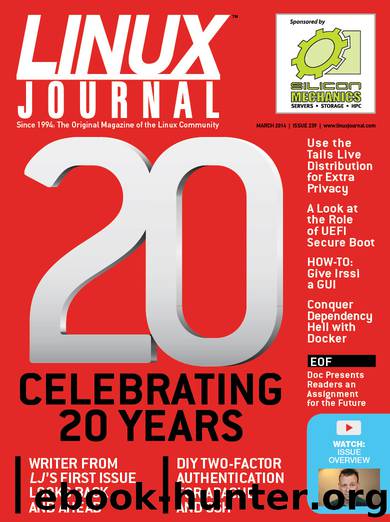
Author:Linux Journal
Language: eng
Format: mobi, epub
Tags: Zombie Dice, Privacy, 20th Anniversary, Irssi, Alice Project, Wampserver, TogetherJS, Therion, Tails, SSH, Linux, Apache, Docker, UEFI Secure Boot
Publisher: Belltown Media
Published: 2014-02-27T08:00:00+00:00
Figure 3. 2013 Device Shipments by Operating System Source: Gartner. Includes PCs, Tablets, and Phones (http://www.gartner.com/newsroom/id/2408515)
Mac OS X was my main platform for much of the 2000s. It puts a nice UI on a deeply functional UNIX foundation. The excellent MacPorts system gives entry to the full catalog of open-source applications. Apple’s XQuartz project enables even GUI X apps to be ported. Users that care about particular scenarios like working with photos, music and video have a platform with great support for those scenarios, because of Job’s attention to end-to-end quality.
Apple has delivered many innovations, but among the most powerful was the successful iOS and later OS X App Stores. Small developers had withered under Microsoft. By enabling software developers to make money, these app stores quickly allowed Apple’s application ecosystem to rival Microsoft’s.
Apple has historically been more willing to sacrifice the compatibility of older applications and hardware. That might have become a problem as Apple’s installed base grew. But the application problem has been mitigated with the strategy of offering free OS upgrades combined with free application upgrades from the App Store. Your current software binaries won’t work several versions from now, but you won’t care because you’ll have downloaded a free update.
Hardware compatibility, however, often has been sacrificed. One gets the sense that Apple sees a robust hardware ecosystem as competing with it, rather than a source of strength for the platform as a whole.
In security, Apple has been both smart and lucky. Smart to build on UNIX. Smart to introduce strict app store criteria and the Gatekeeper feature to steer users away from untrusted apps. But it also has been lucky to stay under the radar. If Windows and OS X’s market shares were reversed, Apple would be forced to have a much higher level of focus on individual exploits, being a monoculture like Windows.
Android and Chrome OS
Google also has kept the tablet and desktop worlds apart somewhat, in the form of Android for tablets and Chrome OS for laptops, both built on the Linux kernel.
Linus’ strategy of benevolent dictatorship for the Linux kernel has delivered stable progress through the years and kept the worst decisions out. However, above the kernel, progress on Linux has been unstable and constantly disruptive...mostly to users, if not to competitors.
With Android, Google’s role has been to provide that stability above the kernel, along with the opportunity for a for-profit ecosystem of software and hardware to build around the platform. The result has been an amazing explosion of Linux-based devices.
With Chrome OS, Google has consummated the process of making the browser the OS. HTML, CSS and JavaScript are the new terminal to the cloud. For those of us who live on the Web and hosted applications, there is enormous peace of mind in having no local software and few security issues to think about—especially when we’re gifting a laptop to grandpa or our daughter, or if we think we’re on the NSA’s naughty list.
Because Android and Chrome OS are open source, whether
Download
This site does not store any files on its server. We only index and link to content provided by other sites. Please contact the content providers to delete copyright contents if any and email us, we'll remove relevant links or contents immediately.
The Mikado Method by Ola Ellnestam Daniel Brolund(27095)
Hello! Python by Anthony Briggs(25950)
Secrets of the JavaScript Ninja by John Resig Bear Bibeault(25286)
Kotlin in Action by Dmitry Jemerov(24396)
The Well-Grounded Java Developer by Benjamin J. Evans Martijn Verburg(23591)
Dependency Injection in .NET by Mark Seemann(23313)
OCA Java SE 8 Programmer I Certification Guide by Mala Gupta(21948)
Algorithms of the Intelligent Web by Haralambos Marmanis;Dmitry Babenko(20852)
Grails in Action by Glen Smith Peter Ledbrook(19869)
Adobe Camera Raw For Digital Photographers Only by Rob Sheppard(17073)
Sass and Compass in Action by Wynn Netherland Nathan Weizenbaum Chris Eppstein Brandon Mathis(16833)
Secrets of the JavaScript Ninja by John Resig & Bear Bibeault(14464)
Test-Driven iOS Development with Swift 4 by Dominik Hauser(12584)
Jquery UI in Action : Master the concepts Of Jquery UI: A Step By Step Approach by ANMOL GOYAL(11866)
A Developer's Guide to Building Resilient Cloud Applications with Azure by Hamida Rebai Trabelsi(10652)
Hit Refresh by Satya Nadella(9239)
The Kubernetes Operator Framework Book by Michael Dame(8588)
Exploring Deepfakes by Bryan Lyon and Matt Tora(8446)
Robo-Advisor with Python by Aki Ranin(8391)
